Power Station's Legendary Sound Signature Continues Nearly Five Decades On, with the Finest Spaces and Tools for Recording - Including Schoeps Mikrofone
An historic studio at the heart of hundreds of iconic recordings, Power Station appreciates Schoeps "timbral detail, clarity, realism and accuracy"
Please find both English and German versions of this press release attached.
Im Anhang finden Sie eine englische und eine deutsche Version dieser Pressemitteilung
New York, New York, December 17, 2025 — After opening in the late 1970s in Midtown Manhattan, Power Station soon established a reputation for the sound of its rooms, a sonic signature that can be heard on some of the biggest rock, pop, jazz and classical releases, film and television scores and Broadway productions released over the past 50 years. To capture its artist clients and the ambience of those tracking spaces with clarity, transparency, consistency and reliability, Power Station has long relied on the finest audio equipment available, including Schoeps microphones, which have been in use at the facility since it opened in 1978.
Power Station was founded in a former Con Edison electricity generating plant in New York’s Hell’s Kitchen in in 1977, operated as Avatar Studios for 21 years beginning in 1996 and, with the support of the New York City Mayor's Office and New York’s Economic Development Corporation as well as the support of musician and investor Pete Muller, became part of the Berklee College of Music in 2017. One of the few major recording studios from the period still in operation, the facility underwent major building renovations around the iconic studios, which were left untouched, and reopened in 2020 as Power Station at BerkleeNYC.
Power Station quickly established a reputation for the sound of its legendary rooms, a sonic signature that can be heard on some of the biggest rock, pop, jazz and classical releases, film and television scores and Broadway productions released over the past 50 years. Continuing to build on that legacy, Power Station at BerkleeNYC has hosted sessions in just the past year or so by the likes of Bruce Springsteen, Ariana Grande, Coldplay, Big Thief, David Byrne, and Jon Batiste as well as soundtracks for Wicked and KPop Demon Hunters, and cast albums for Maybe Happy Ending, Gypsy and Cabaret — most of them making use of Schoeps microphones.
“I would say that we grab Schoeps when we are looking for timbral detail, clarity, realism and accuracy when you're trying to capture a sound as it exists in the room,” says Ben Miller, Studio Operations Lead, Power Station at BerkleeNYC, who has worked at the facility since 2017. “Things already sound so great in the rooms, but we can shape that with placement, polar pattern and mic choice.”

Schoeps: an invaluable tool to have
Schoeps brand products have been in the mic locker almost since Power Station opened, helping engineers, producers and their clients accurately capture vocals and instruments in the facility’s celebrated acoustic spaces. “What makes Schoeps stand out is their clarity and transparency,” says staff engineer Neal Shaw. “Many other companies in the classical space lean brighter. Schoeps never feels overly bright to me. Instead, they bring warmth and width that others don’t. While added brightness can help in some darker halls, Schoeps’ unique color is an invaluable tool to have.”
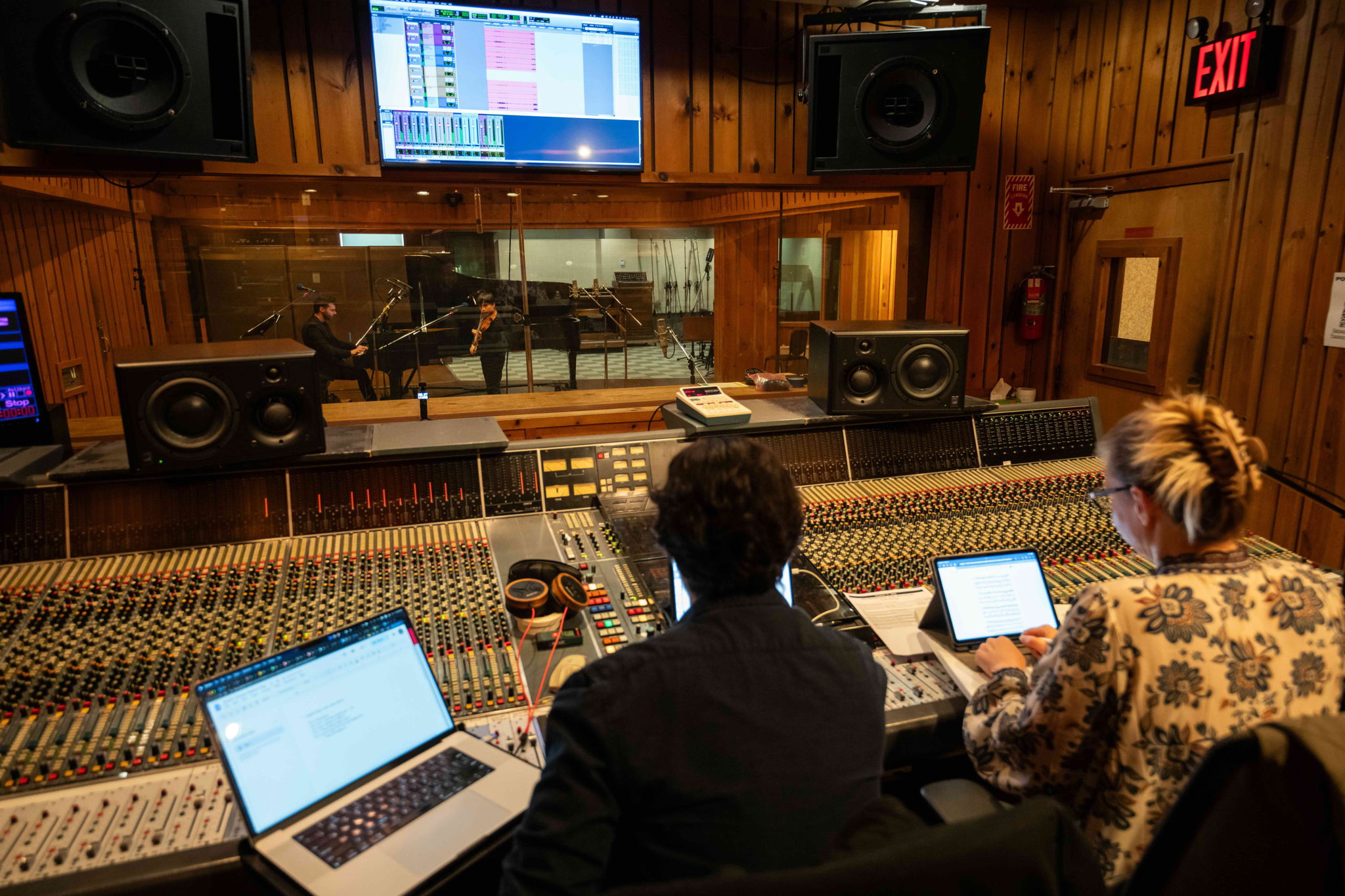
Power Station offers four rooms that cater to a variety of clients. Studio A lends itself to tracking ensembles of up to 60 people; the cozier Studio B is suitable for small bands and overdubs; Studio C’s dimensions and booth layout make it ideal for jazz big bands; and Studio G is perfect for solo musicians, mixing and overdubbing.
“At Power Station, we’ve got six Schoeps: two CMC 5s with MK 4 caps and four CMC 6s with switchable MK 5 caps,” Shaw elaborates. “These shine on string dates in Studios A and C. With many musicians, the room can sometimes be a bit brighter than a concert hall, and Schoeps mics balance things beautifully. They’re consistent mic to mic, which makes them excellent for string spots, or with MK 5 caps flipped to omni, as wides/flanks to capture the room. I’ve also used them on piano for jazz sessions and on theorbo and classical guitar with a baroque ensemble. On big band dates and cast albums, our Schoeps often go on woodwinds like flute, clarinet, oboe or soprano sax.”

Versatility that extends beyond music production
Power Station attracts more than just music production clients, many of whom also value Schoeps mics. “We see Schoeps regularly on dialogue and ADR sessions for film,” Shaw also reports. “The CMIT 5 is such a standard on sets that we often rent them to match the production sound.”
Henry Reinach, an assistant engineer and engineer at the studio, chimes in, “I use a pair of CMC 6s with MK5 capsules on piano over the keys all the time; it’s one of my favorite ways to mic our pianos, especially in Studio B. The C7 in that room is super warm and mellow, and the Schoeps mics capture a lot of exciting high end out of it that balances it out.” He also uses Schoeps mics on acoustic guitar, both for mono miking and double tracking, and stereo acoustic recording. “They are super crystal-y and get a lot of nice detail for fingerpicking or more intimate playing.”
Many visiting freelance engineers, as well as the staff, have worked in the rooms so much that they know exactly which mic to use on a given source, and Schoeps mics offer the consistency and predictability to allow any session to run efficiently. “If you're doing a large orchestral session with 50 people and you have 80 mics up, you don't have the time or the money to listen to every single microphone in every single place and adjust the positioning or the microphone,” Miller says. “You need to know exactly what everything is going to sound like when you're setting it up. You don't even need to look at the mic that's on the input list. You can just see, this is a reed high mic, so I know it's going to be a Schoeps. I know the piano hammers are going to be the CMC 6s with a cardiod capsule.”
Power Station’s tracking spaces are highly revered for their acoustic qualities and engineers will often reach for Schoeps mics to capture that ambience, especially in Studio A, with its 35-foot vaulted pinewood ceiling. On string dates, Reinach says, “I’ll position an XY pair of Schoeps mics near the conductor. I did that for strings on an upcoming album for Matilda Marigolds. I also used Schoeps for room mics on vocals for an upcoming film score that had a quartet of singers.”

Recording the New York Philharmonic with dozens of Schoeps mics
Miller recalls an outside project that he worked on, a film scoring session at the Manhattan Center, that demonstrated the Schoeps brand’s popularity and prevalence in the city. “We rented every single Schoeps CMC 5 and CMC 6 in New York City: 50-plus mics from four different sources for a 100-plus-person configuration of the New York Philharmonic,” he says.
Shaw, too, frequently relies on Schoeps mics when working outside the Power Station. “I use them often with WQXR for live broadcasts at Carnegie Hall and the Naumburg Bandshell in Central Park. The Colette series, especially the MK 2H, are hung over many sections. I’ve been saving to buy three MK 2H caps with spheres. With one possible exception, he adds, “I couldn’t think of a better mic for a Decca tree. I also love the flexibility of the wider cardioid, like the MK 21 and MK 22, over certain sections that wouldn't benefit from omni mics.“
While New York City’s competitive real estate market has led to many major studios closing over recent decades, Power Station at BerkleeNYC is one of the few temples of sound left standing in Manhattan, putting the facility in a unique position. “The service that Power Station provides to the music industry in New York City is irreplaceable,” Miller says. “We're the only place left that can do what we do.”
SCHOEPS Microphones
Founded in 1948, Schoeps Microphones are pioneers in the world of pro-audio with a reputation as one of the world's finest manufacturers of microphones. The family-owned business, based in Durlach, Karlsruhe, Germany, designs and manufactures all of its products in-house with a team of 50 employees. The company is driven by a passion for innovation, technical excellence, and strong relationships with the creative and technical professionals who have made Schoeps a part of their daily workflows.
For more information about Schoeps Microphones, please visit: https://schoeps.de/en/