Electronic Music Pioneer Richard Devine Expands his Sonic Palette with AJH Synth Entropic Doom, Triple Cross, and Chance Delay
Devine appreciates AJH Synth analogue design, build quality and different modulation possibilities: "These are great modules to rethink how you are going to patch."
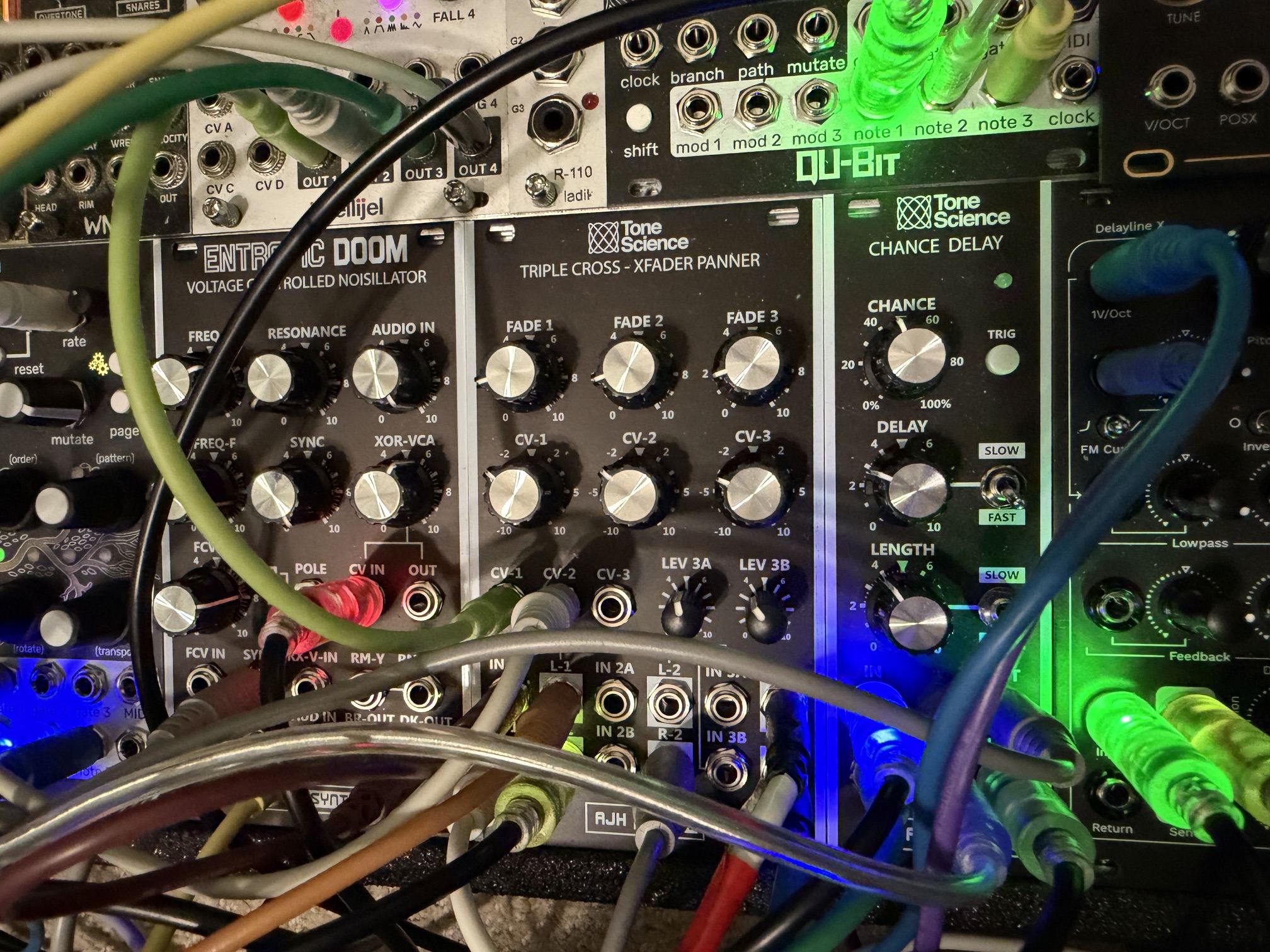
Atlanta, Georgia, March 25, 2026 — As a modern-day pioneer in the world of synthesis and electronic music, Richard Devine is constantly expanding and refining his musical canvas, taking advantage of the latest innovative tools in the world of Eurorack and beyond. An acclaimed sound designer for some of the largest companies in the world and an artist having released seven albums in his own right, Devine is always looking to fortify his sonic playground. Recently, he added three AJH Synth modules to his arsenal including the Entropic Doom Noisillator, the Triple Cross XFader Panner, and the Chance Delay.
"These three modules were the first I've ever tried from AJH, but I’ve seen them being used by many artists I admire, like Colin Benders who is a good friend of mine," says Devine. "I was immediately impressed by the quality and feel of these modules: the switches, the way the components are mounted together, and the feel of the knobs, you can just tell right away that this is sturdy, very well constructed modules."

Creating tundral winds with Entropic Doom Noisillator
"The first AJH Synth module I experimented with was the Entropic Doom Noisillator," he says. "I love noise - especially all the different timbres and styles of noise. In fact, I think I have tried almost every noise generator that is out there." For Devine, who works a lot with synthesized drums, he appreciated that he could 'tune' the noise to suit a desired rhythmic context by sending in an external signal using FM modulation. "I’d never had that ability with a noise-based source before, and this was always a big problem with my other noise generators. It makes all the difference when you are working with drums, and the Entropic Doom soon became my new favorite hi-hat oscillator since I could tune it to the root note of the track."
He also realized that Entropic Doom was not a one-trick pony. "This module is also great for making weird, massive drone sounds like tundral winds and sweeping sea [?] sounds. The variety of sounds it was capable of really surprised me, including the ring modulator, which could be used as a module on its own right too. It would take three or four modules to do what the Entropic Doom can do on its own - it's very multi-functional."

Controlling randomisation with the Chance Delay
Devine sees the AJH Synth Chance Delay as the perfect companion to a live set: "Since it is only 8 HP and so powerful, it is perfect for use in a live situation because I love probability, chance and randomness in my live shows. I almost think of it as free jazz performance," he says. "Sonically, it was very akin to a Curtis Rodes type of sound," he observes. "I was primarily using the pulses to trigger gates, but it was also really cool for triggering percussion sounds like random drums and sequencer-based drum patterns."
Devine says he also loved the versatility of the Chance Delay, saying that would have needed several modules to achieve what this module does in just 8 HP: "It was the best random pulse generator I’ve ever used, by far. It's a really clever design with its chance, delay and length knobs, and full CV control over these outputs. I was getting a lot of really interesting variation and it was perfect for generating random pulses."
Mixing exotic signals with Triple Cross XFader Panner
Another module developed in collaboration with Ian Boddy, Triple Cross features three independent cross fader and panner channels - and can be used with both audio and CV signals. "I ran three granular synths into the audio inputs of Triple Cross and was able to create all these crazy patterns using its cross fades and panners," he says. "The CV input runs audio rates too, which means you can get some very unconventional sounds when you start modulating at 5k and above. I use an Intellijel Quadrax Quad LFO and ran it through the Triple Cross and was able to get many different cool combinations."
"It is interesting to hear the ways in which the two signals play off one another, depending on the CV in between the 1 and 2 channels," he adds. "I also love having the CV level attenuators; with these, you can really push sounds right to the bleeding edge. It is a really well designed, smart module, and is perfect for either in the studio or live."
Leveraging a playground of ideas
"These things are built so well and the ideas coming out of AJH are so fresh and inviting," Devine concludes. "All three of these modules really invite the user to come in, experiment and try different modulation possibilities. They are great modules to help re-think how you are going to patch; and trying out new possibilities is one of the best things you can expect out of an instrument."
To learn more about Richard Devine, or to listen to his new EP Systik, please visit https://www.richarddevine.com/.
About AJH Synth
AJH Synth is headed up by Allan J Hall, who has been involved with synths, electronics and music for several decades. He started by building a guitar fuzz box at the tender age of 12 and his interest in synthesisers and electronic music soon followed, fuelled by an unhealthy overexposure to early Tangerine Dream, Pink Floyd, Vangelis and Kitaro. For the last 15
years he has been building and modding synth systems both for himself and other electronic musicians, as well as spending some time as a semi-pro musician playing keyboards in several rock and tribute bands. Allan spent five years as a service technician repairing and modifying Moog, Arp, Korg, Roland and other analogue synthesisers along with some Pro Audio design work, previous to this he spent two years designing and building "boutique" valve (tube) guitar amplifiers. AJH Synth are based near Durham, in the northeast of England, where this small but enthusiastic bunch of synth heads now indulge their passion for all things modular.

Jeff Touzeau


2506_AJH_RichardDevine.docx
DOCX 69 KB