Bureau B to Reissue 50th Anniversary, Vinyl-Only Limited Editions of Classic Albums Heldon IV and Heldon V
Heldon's transcendent, mind-bending albums 'Agneta Nilsson' (Heldon IV) and 'Un Rêve Sans Conséquence Spéciale' (Heldon V) will be released on May 22nd
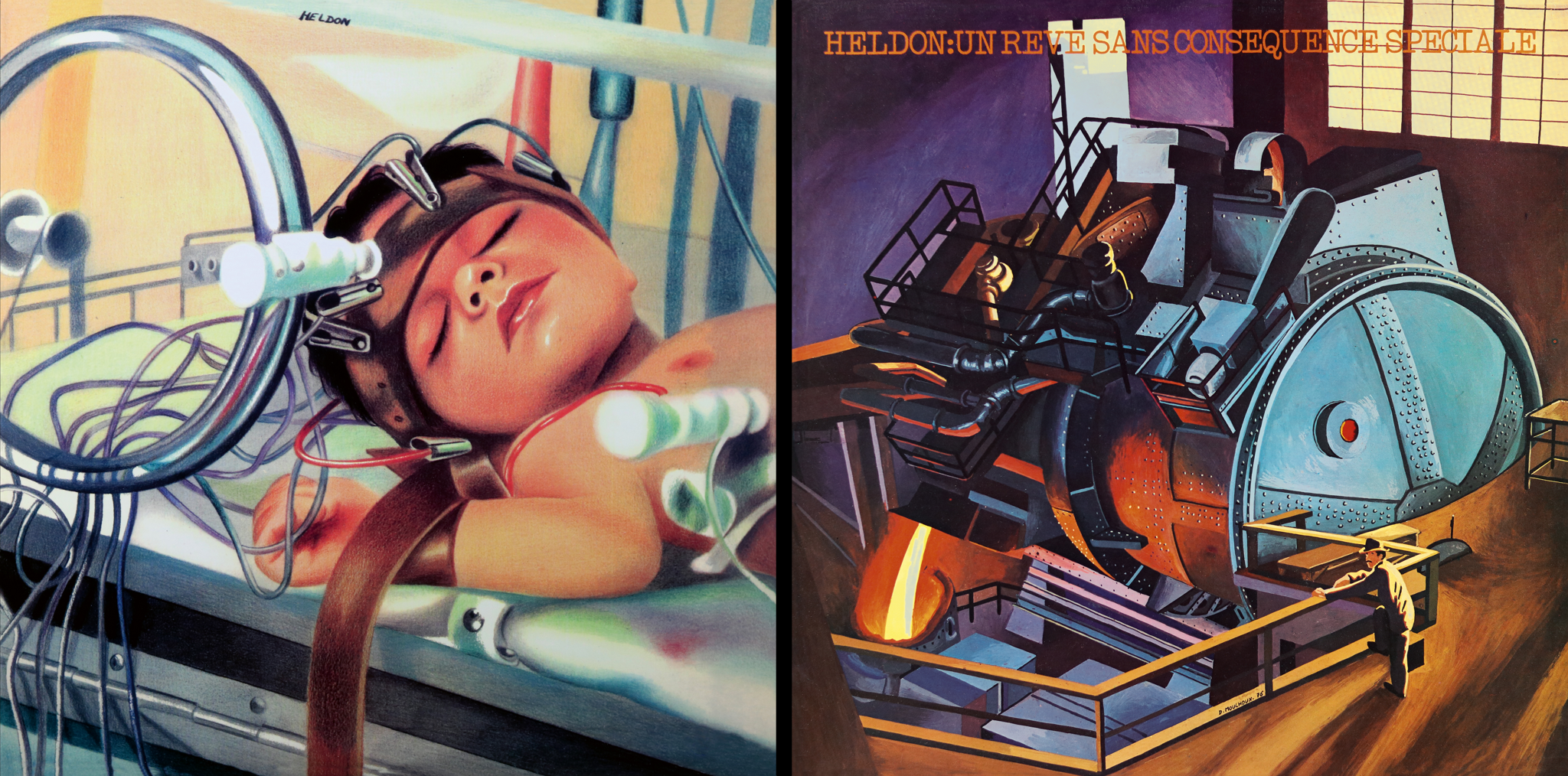
Hamburg, Germany, May 16, 202 — Bureau B announces two forthcoming re-releases by Heldon, the pioneering French ensemble led by Richard Pinhas that effortlessly blended experimental rock and hard-driving analog synthesis. The two albums, Agneta Nilsson (Heldon IV) and Un Rêve Sans Conséquence Spéciale (Heldon V) will be released on May 22nd and strictly limited to 500 vinyl pressings each - both albums will be hand-numbered on red and orange colored vinyl respectively.
'Agneta Nilsson' (Heldon IV)
Heldon's fourth album, Agneta Nilsson, originally released in 1976, sees Richard Pinhas and his changing entourage of musicians delve even deeper into Heldon's sonic universe. Their trusted array of hypnotic synthesizer sounds is underscored in places by drums and/or guitar.

Agneta Nilsson opens with a mind-paralyzing track that proves stillness can have a pulse. “Perspective I” spends ten minutes poring through tectonic layers of heavy sound, piling everything so thick that the song becomes like quicksand for your brain. It’s one of the most daunting works in the Heldon catalog, made all the more impressive by how simple it is. It’s just sounds put together and turned up. It’s the vital alchemy of Richard Pinhas’s wizardry, deployed with maximum force.
As on other early Heldon albums, the rest of Agneta Nilsson is diverse in a nearly contrarian way. Each track refuses to mimic its predecessor in a way that feels rebellious, like a child running away from home. This is true despite the fact that three of the four pieces are actually chapters of “Perspective,” partners in a thematic whole. “Each one is a different point of view on the same field,” explains Pinhas. “Different parts, different arrangements, but with a full concept in place.” It’s not easy to divine that concept in these pieces, but their sibling nature has a subconscious effect.
The album-closing “Perspective IV” is one of Pinhas’ most unabashedly proto-prog guitar-hero epics, boosted by a technical upgrade. “This was the first album where I had enough money to rent one or two days in a real studio to do the drumming,” says Pinhas. “After that we had real budgets for studio time. That all changed with and after Agneta Nilsson — that was a good turn."
Pinhas parlayed Heldon’s change of direction into three more adventurous albums in the 70s, and simultaneously spurred himself toward a solo career that continues to prod and probe the sonic universe today - over 40 years since he began. It would be wrong to say this album was the big bang of this singular career; the seeds of were planted years before, and every work Pinhas has been involved with sprouts more sounds and ideas that can grow into their own branches. But Agneta Nilsson is one of the most convincing pieces of evidence that Pinhas in incapable of sitting still.
'Un Rêve Sans Conséquence Spéciale' (Heldon V)
Richard Pinhas made it clear that a significant font of inspiration was Robert Fripp’s guitar style and melding of rock music with cutting-edge electronics. Indeed, Heldon’s fifth album Un Rêve Sans Conséquence Spéciale, also originally released in 1976, was named after a live bootleg of a King Crimson concert. Pinhas first met Fripp in 1974 and the pair have remained in contact ever since. Pinhas was even offered a deal with E.G. Records, the company that oversaw King Crimson alongside other successful groups like Roxy Music and ELP. “That was a dream” says Pinhas.“But when you are 22, you are in a hurry. They asked me to wait one or two years before joining the team. I couldn’t wait two years! At 22, two years is too much.”

Instead, he launched his own label, Disjuncta, which he later sold to purchase the Moog synthesizer that would make a huge difference to Heldon’s sound. Heldon’s output also drew from radical science fiction (Philip K. Dick, Norman Spinrad, etc.) as well as philosophy: The sleeve features a quote from Pierre Klossowski’s Nietzsche and the Vicious Circle (1969). Pinhas compares his readiness to signpost his influences to citations in academic publications: “In the field of philosophy at university, it’s a normal thing to do.” Besides, Heldon never represented a mere facsimile of Pinhas’ musical touchstones: King Crimson, Jimi Hendrix, Miles Davis, or Frank Zappa.
Heldon was always its own beast and by 1976 it was thriving and roaring like never before. More work was being completed in a proper studio, the Moog helped strengthen the sound and direction, and Pinhas’ rotating cast of collaborators was solidifying into something resembling a regular line-up, with François Auger on drums and Patrick Gauthier on synthesizers. The result was a darker, heavier, and more intense sound.
Un Rêve Sans Conséquence Spéciale opens with the prog-gone-skronk onslaught of "Marie Virginie C", sounding rather like Robert Fripp being sliced into bloody chunks in Thurston Moore’s basement. Auger is the star of "Elephanta", in all its Moog-assisted polyrhythmic glory. On side two, "MVC II" offers six minutes of sinister dystopian squelch rock. It’s followed by Toward The Red Line, an epic piece conceivably serving to connect the dots between Hawkwind’s most freeform passages and the Detroit techno innovations of the coming decade. Needless to say, Heldon’s influences had been transcended.
For more information on this and other Bureau B releases, please visit https://www.bureau-b.com/releases.
About Bureau B
Bureau B is platform for exciting varieties of electronic, free-spirited music. The spectrum ranges from pop to avant-garde, and the label has amassed an impressive catalogue of reissues and new productions in recent years, including classics from the genre of electronic music in the 1970s and early 1980s popularly classified as Krautrock (Cluster, Roedelius, Moebius, Plank, Schnitzler), alongside new recordings by such formative artists as Faust, Kreidler, Roedelius, Tietchens, Moebius, to name just a few. Bureau B is based in Hamburg, Germany.

Jeff Touzeau