Rare Moog Liberation Keytar Synthesizer Formerly Owned by Gary Wright Donated to the Bob Moog Foundation Archives
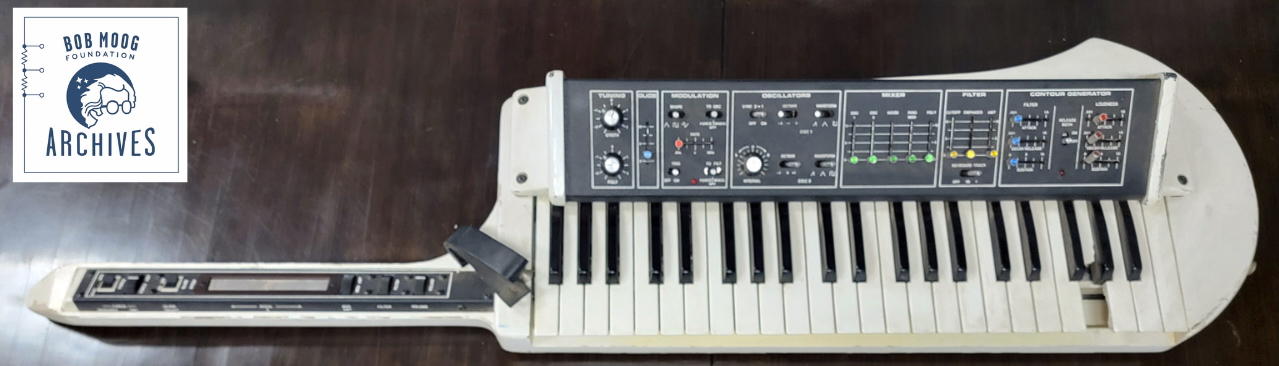
March 30, 2026 (Asheville, NC) — Keyboardist and synth programmer Casey Young recently donated a rare, vintage Moog Liberation keytar synthesizer to the Bob Moog Foundation Archives. Notable musician and performer Gary Wright previously owned the synthesizer. Manufactured in 1980, its serial number is 8041, and it is treated with a rare white factory paint exterior. It is accompanied by two external power supply and interface boxes.
.jpg)
The Liberation is one of the earliest examples of wearable “keytar” synthesizers. An adjustable, leather strap is attached at opposite ends of the instrument so that it can be held like a guitar. This wearable feature allows an otherwise stationary keyboard performer the freedom to move about and interact with other musicians. Connecting the Liberation to an interface and power supply unit allows it to send audio output while receiving power through a single cable.
Of particular note, the Liberation is one of the few keytars of its era to include a built-in sound-generating synthesizer, as MIDI (Musical Instrument Digital Interface) would not be introduced until 1983. As the keytar form factor gained popularity in the coming decade, lightweight MIDI-enabled instruments emerged, requiring far fewer electronics, since the synthesizer itself could be controlled remotely. The Liberation, with its inherent heft, had a very short production run that ended in 1981, resulting in the product’s rarity and collectibility.
Gary Wright, writer and composer of classic songs including “Dream Weaver” (1976), was notable for using keytar synthesizers during live performances. The white Moog Liberation appears in his 1981 music video for “Heartbeat.” Ownership of this synthesizer was transferred to musical collaborator Casey Young, who maintained possession until donating it to the Bob Moog Foundation Archives.
“Getting to work with Gary Wright was one of the best gigs I ever had,” noted Casey Young, whose musical collaborators also included Yes, Madonna, TOTO, Michael Jackson, and Tina Turner. “He did so much to jump-start my musical journey.” Young explains that Moog Music, while sponsoring the band, donated the use of three black and one white Liberation for the “Heartbeat” video. Young was later gifted the white Liberation by Wright while the remaining three were returned.
The Foundation’s goal is to restore the Liberation’s full functionality and cosmetic appearance for eventual display and hands-on use at the Moogseum in Asheville, North Carolina. This is the second Moog Liberation synthesizer in the Archives collection.
“We are honored by this very special donation to the Bob Moog Foundation Archives,” noted Michelle Moog-Koussa, Executive Director of the Bob Moog Foundation. “Gary Wright’s Liberation is a part of synthesizer history. We are deeply grateful to Casey Young for this important donation, and we look forward to sharing this historical gem once it has been restored.”
About the Bob Moog Foundation Archives
The mission of the Bob Moog Foundation Archives is to preserve an extensive collection of materials related to Bob Moog's legacy and to share many items of historical note at the Moogseum. Included in the archives are vintage instruments and prototypes, over 5,000 photographs, and over 3,000 schematics, many of them hand-drawn originals. To learn more, visit https://moogfoundation.org/projects/bob-moog-foundation-archives
About the Bob Moog Foundation
Founded in 2005, the Bob Moog Foundation is dedicated to carrying on the innovative legacy of synthesizer pioneer Bob Moog. Through programs like Dr. Bob’s SoundSchool, the Bob Moog Foundation Archives, and the Moogseum, the organization inspires the next generation of musicians and innovators by blending science, music, technology, and education. For more information, visit https://moogfoundation.org/

Hunter Williams
.jpg)