Harrison Audio 32Classic Lands at APSoon Recordings in Estonia
New console will be used to capture and mix recordings of jazz and classical ensembles. "Everybody said, ‘If you want a console with warmth, clarity and zero coloration, then you have to choose the Harrison.’ So I placed the order — and I'm very happy."
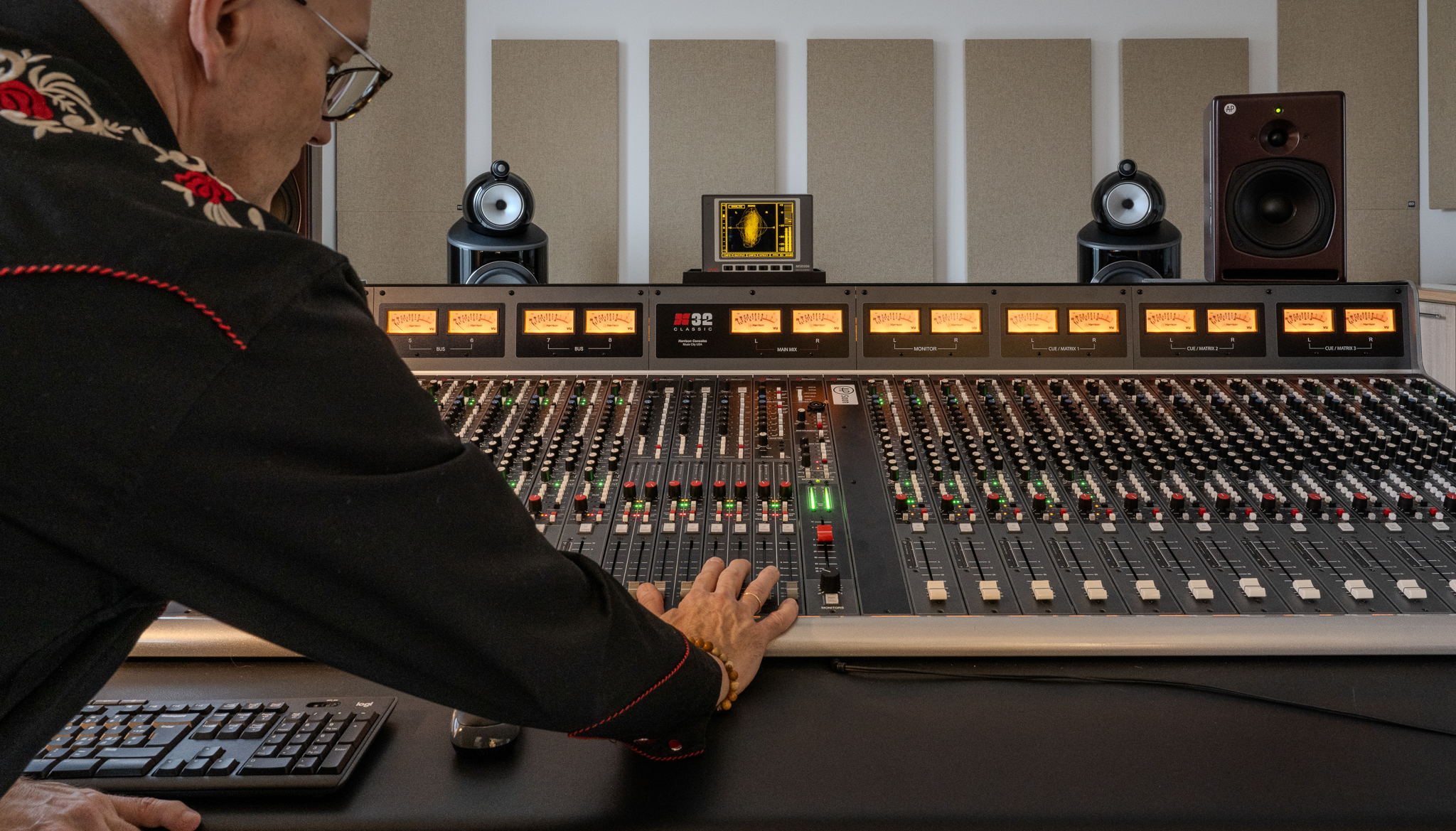
Paide, Estonia, February 19, 2026 — APSoon Recordings recently installed a Harrison 32Classic analogue console in its studio in Estonia, where it is used to mix live, acoustic recordings of jazz and classical ensembles as well as church pipe organs captured to high-resolution DSD (Direct Stream Digital). The 32Classic, a modern-day successor to Harrison’s renowned 32C console of the 1970s, was selected for its lack of coloration, responsive EQ and filter section, and input channel and group insert capabilities.
The company’s founder, Aular Soon, a trained electronics engineer, purchased the new 32Classic sight unseen after thoroughly researching his options and speaking to several engineers and producers. The other analogue consoles that he was considering colored the audio in one way or another and didn’t meet his requirements, he discovered. “Everybody said, ‘If you want a console with warmth, clarity and zero coloration, then you have to choose the Harrison.’ So I placed the order — and I'm very happy,” he reports.

Recording in high definition with 32Classic
APSoon Recordings produces, records and releases projects captured in acoustically suitable halls and churches in Estonia using a mobile system of very high-fidelity audio equipment. Soon produces and engineers the projects, alongside fellow engineer Priit Kuulberg. “I make my recordings in the hall or church, using the natural reverb as much as possible,” Soon explains. He then takes those recordings — captured to the high-definition DSD 256 digital format, which offers 256 times the resolution of a compact disc — back to his studio. “The DSD format is not editable, so I use it just to capture the purest sound. After that, I need to do some mixing,” he says, to re-balance the relative levels between individual musicians or address problems such as rumble or other undesirable noise.
It is very important, therefore, that the console should not introduce any coloration to those initial recordings. But when Soon does need to make some corrections, he says, “The Harrison EQ is awesome, because if you turn it even one decibel, you can hear it,” unlike some of the consoles from other major brands that he has used previously. The 32Classic’s filter section is also critical to the record label’s productions. “I need to use the high-pass filter to clean up some sub low frequencies such as rumbles and so on.” Overall, he says, “It’s exactly what I was looking for, a warm and silky sound.”
The importance of inserts
There was one other feature that attracted Soon to Harrison’s 32Classic, something that was completely missing from one of the other, more expensive mixing console options he had been considering, namely, inserts on the input and group output channels. “How can you work without inserts? Sometimes, when recording jazz, the musicians might not play at an equal level, and then you must use some compression. That's normally what I do if it's necessary, and therefore I need inserts,” he says.
“I am a very, very big fan of original UREI compressors, and have 10 LA-4 from the ‘70s,” he continues. Whether he inserts a compressor on the input channel or a group channel depends on the source, he says. For drums, as an example, he inserts two mono compressors on one of the Harrison console’s stereo groups. Soon will often record an upright acoustic bass with three microphones, which he will combine before compressing. “I will mix the three different mics together and get a special, special sound,” he says. “I never use just one mic to capture acoustic guitar. I always use two, then I can mix them together and have all the details covered.” He sometimes uses two mics on vocals, he adds. “But if I just use one mic then I insert a single compressor on the input channel.”
AP Soon's inagural project on 32Classic
If he is mixing a small jazz ensemble, Soon continues, “I will use a special vintage compressor to keep this smooth and levelized sound. But, of course, I never use a compressor to the extent that there is no dynamic left. For me, music should be dynamic.” The label’s projects, which are sometimes mastered to a Studer 810 2-track tape machine, are released on vinyl through APSoon Recordings’ online store. The first project mixed through the new Harrison 32Classic, the Gourmet Quartet’s ”Fragments of Time,” an unedited and uncut live performance of jazz standards recorded at an Estonian music school, was released in mid-August as a DSD 256 download on Native DSD’s online platform.
“The sound of the Harrison console is delicious,” he says in conclusion. “and I really like that you can use any type of mic using its transformer-balanced mic pre, and you can bring sounds together so easily. The Harrison 32Classic is exactly the tool that I need.”
About Harrison
Harrison has been designing, manufacturing, and marketing audio mixing consoles in Nashville, Tennessee (Music City, USA) since 1975. Our products serve the markets of music recording/mixing, international film and television sound production, audio post production, broadcast sound, and live sound reinforcement. Over 1,500 Harrison consoles have been installed worldwide, constituting a significant share of the overall world market for high-end audio consoles. Harrison's dominance of the high-end market demonstrates that customers who require solutions to complex problems invariably turn to Harrison to provide the answer.

Jeff Touzeau


HarrisonAPSoon FINAL.docx
DOCX 37 KB